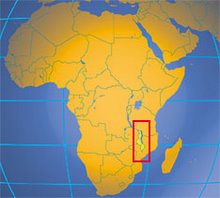
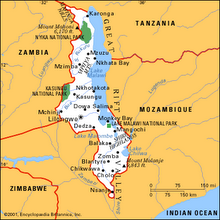
I am slowly getting settled here in Lilongwe. I have moved here for a few weeks, or maybe months (we’ll see), to work out of the head office while I start on some new projects. While it’s good to be back in a bigger city and a treat to take advantage of all the comforts the city provides - regular access to email, a variety of food options, more consistent power, etc. – however, I am also very, very much missing my family in Machinga and the comfort and support that I had there. It’s amazing how much these others things (email, food options and power, for example) don’t mean as much as family and support. Moving and having to adjust to a new city, new projects at work and a new home has been a bit overwhelming but slowly as I settle into a new routine it is getting easier.
I am living with the fiancé of Enellece, a Malawian friend of mine from Machinga. Frank is a tobacco breeder, who works for an agricultural research trust, experimenting with different tobacco strains, trying to breed varieties that are higher yielding, more resistant to pest attacks or certain climate conditions. Tobacco, or “green gold” as it is called here, is Malawi’s biggest export crop. I would’ve thought “green gold” would be maize as it is grown everywhere but apparently it is grown predominantly for local consumption and does not bring in much, if any, export money. Tobacco, therefore, is a very important crop and a lot of money and effort is spent on ensuring its successful production.
We also live with, and I share a room with, Frank’s cousin Grace. She is a 23 year old who is doing a diploma at a local college in business administration. She is quite sweet and has become something like a little sister. She likes to do my hair up in curlers and then get it all styled so I look “quite smart”. I think it just looks big! We play cards in the evening or I teach her some basic computer skills. I was quite worried when I moved in that I had invaded her room, and with all my stuff, it’s not like my presence can go unnoticed! But despite the invasion, she seems happy to have another girl in the house to do things with and I am very happy for the company as well.
So there have been many changes recently but as things settle down I’m becoming more comfortable again. The small town girl is getting used to the big city! I’m looking forward to sinking my teeth into my new projects at work. They all seem a bit overwhelming at the moment but hopefully, as I work away at them, they will become more manageable.
Stay warm and I’ll try to stay dry! The rain is becoming almost daily now!
Monday, January 28, 2008

Sunday, January 13, 2008
I'm Simple...
One of the most emotional times over the holidays was a few hours spent with one of my Chichewa teachers in Machinga. Chrissy, a kindergarten teacher and Albert, a high school English teacher, were a perfect pick for my language lessons. Good teachers with lots of energy, this couple was always willing to spend a few hours pouring over my notebook and small language text as I tried to learn. Chrissy would prepare popcorn or roasted peanuts and we would munch away, laughing at my mistakes until my brain was fried. Afterwards we would sit and play cards or checkers, bouncing their son Domenic on our laps, usually talking about Canada as they were very curious about everything from the politics to sports, from the weather to employment.
More than my teachers, though, this couple became some of my very good friends. Over Christmas, Marc and I gave them a book on Canada, with pictures and descriptions of the country and its vast and varied environment and landscape. We spent one afternoon for a few hours sitting with Chrissy and talking about Canada. Laughing as she asked questions about the ice on the rivers or the changing colours of the trees. “I would never survive” she said as she gasped at the snowy landscape.
As we were leaving her house and I was saying good bye as I was leaving Machinga for a few months to spend some time working in the head office in Lilongwe and do some research in another district, she said some things that made me think. In thanking me, she got very quiet and serious. She not only thanked me for the gift but for my friendship. “When I see you in town and I’m with my friends, they ask me about you. She’s different, I tell them. She’s simple. She’s like us”. You are not like others, she said. You are simple and humble. When you first came and were living here in Machinga, we all worried how you would be, living in these conditions coming from a country that is so different and more advanced. But you have no problems. You eat what we eat. You treat us no differently. You treat us as equals, we have good talks and we are friends.
I was extremely moved by her words but also saddened. Why should she expect me to treat her or anyone else differently? Why should they worry about how I will live in “these conditions” when they do so everyday? Why should she be surprised by my actions and thank me? But the sad part is that in rural areas, the vast majority of Malawians are surprised when they are treated as equals by foreigners. They are surprised that we can survive without flush toilets and stoves, creature comforts and knives and forks. But there must be a reason why they are surprised. They must have not been treated with respect enough times in the past that when they are, it seems “different” or “surprising”. It makes me more eager and determined to break down these stereotypes at every opportunity. Everyone has prejudices. But we are all human beings and need to work to remove these prejudgements, good or bad, about others because of where they come from or the colour of their skin.
More than my teachers, though, this couple became some of my very good friends. Over Christmas, Marc and I gave them a book on Canada, with pictures and descriptions of the country and its vast and varied environment and landscape. We spent one afternoon for a few hours sitting with Chrissy and talking about Canada. Laughing as she asked questions about the ice on the rivers or the changing colours of the trees. “I would never survive” she said as she gasped at the snowy landscape.
As we were leaving her house and I was saying good bye as I was leaving Machinga for a few months to spend some time working in the head office in Lilongwe and do some research in another district, she said some things that made me think. In thanking me, she got very quiet and serious. She not only thanked me for the gift but for my friendship. “When I see you in town and I’m with my friends, they ask me about you. She’s different, I tell them. She’s simple. She’s like us”. You are not like others, she said. You are simple and humble. When you first came and were living here in Machinga, we all worried how you would be, living in these conditions coming from a country that is so different and more advanced. But you have no problems. You eat what we eat. You treat us no differently. You treat us as equals, we have good talks and we are friends.
I was extremely moved by her words but also saddened. Why should she expect me to treat her or anyone else differently? Why should they worry about how I will live in “these conditions” when they do so everyday? Why should she be surprised by my actions and thank me? But the sad part is that in rural areas, the vast majority of Malawians are surprised when they are treated as equals by foreigners. They are surprised that we can survive without flush toilets and stoves, creature comforts and knives and forks. But there must be a reason why they are surprised. They must have not been treated with respect enough times in the past that when they are, it seems “different” or “surprising”. It makes me more eager and determined to break down these stereotypes at every opportunity. Everyone has prejudices. But we are all human beings and need to work to remove these prejudgements, good or bad, about others because of where they come from or the colour of their skin.
Saturday, January 12, 2008
Christmas in Machinga
Happy New Year! I hope everyone is settling well into 2008 and had a safe and happy holiday season!
My Christmas holiday this year was spectacular! I had a wonderful few weeks traveling around the country with Marc, my boyfriend who came to visit from Ottawa. It was wonderful to be able to share some of my experiences with him, for him to meet all of my friends and family and as well, to explore some new and exciting places together.
Before Marc’s arrival, the days leading up to Christmas were fairly uneventful. But when Marc arrived, it was like Santa Claus stepped off a plane! He arrived with an enormous bag of gifts, not just for me but for the Kachifumbu’s in Machinga. I was truly overwhelmed and humbled by the thoughtfulness of friends and family back home. The meaningful words in Christmas cards, the CD of Christmas carols, the pictures and all the gifts were very special, stirring up a lot of emotions – missing everyone at home, being proud of what I’m doing here but most of all, feeling very truly blessed and lucky to have so many special people who support me. I thank each and every one of you for your thoughts and wishes. You cannot begin to know how much it means…
We spent Christmas with the Kachifumbu family in Machinga, and it truly was a wonderful day. Florence and I spent Christmas Eve preparing a Christmas cake while Marriot and Marc went off to church. When I say “Christmas “cake it was actually a white cake complete with dried cranberries from Canada, icing and sprinkles – a special treat as Florence had requested a “Canadian” cake for Christmas. That night, Marc and I stayed up late and played Santa Claus. It was so fun! After everyone went to bed, we snuck into the sitting room and decorated a Christmas tree we bought, put up photos we had developed and laid out all of the goodies for the family under the tree.
My Christmas holiday this year was spectacular! I had a wonderful few weeks traveling around the country with Marc, my boyfriend who came to visit from Ottawa. It was wonderful to be able to share some of my experiences with him, for him to meet all of my friends and family and as well, to explore some new and exciting places together.
Before Marc’s arrival, the days leading up to Christmas were fairly uneventful. But when Marc arrived, it was like Santa Claus stepped off a plane! He arrived with an enormous bag of gifts, not just for me but for the Kachifumbu’s in Machinga. I was truly overwhelmed and humbled by the thoughtfulness of friends and family back home. The meaningful words in Christmas cards, the CD of Christmas carols, the pictures and all the gifts were very special, stirring up a lot of emotions – missing everyone at home, being proud of what I’m doing here but most of all, feeling very truly blessed and lucky to have so many special people who support me. I thank each and every one of you for your thoughts and wishes. You cannot begin to know how much it means…
We spent Christmas with the Kachifumbu family in Machinga, and it truly was a wonderful day. Florence and I spent Christmas Eve preparing a Christmas cake while Marriot and Marc went off to church. When I say “Christmas “cake it was actually a white cake complete with dried cranberries from Canada, icing and sprinkles – a special treat as Florence had requested a “Canadian” cake for Christmas. That night, Marc and I stayed up late and played Santa Claus. It was so fun! After everyone went to bed, we snuck into the sitting room and decorated a Christmas tree we bought, put up photos we had developed and laid out all of the goodies for the family under the tree.

After Santa's visit
Sleeping that night was difficult with all the excitement and anticipation but all tired thoughts were forgotten as we listened to the gasps, the giggles and whispers at the discovery on Christmas morning. We spent about 2 hours opening presents, one person at a time, relishing every moment – dinky cars and dolls, clothes and soaps – all the while laughing with excitement and enthusiasm with the unwrapping of each item. It was also very emotional – both for me and them. It was so nice to see this family – my family – who has given me so much, taken me into their home and their family as if I belong, never making me feel different or strange, they have taught me so much, they have loved and supported me, talked with me and comforted me – it was so nice to see them so happy and overwhelmed. To be in some small way, if only for a few hours, a part of creating so much joy. To see them so overwhelmed by the gifts themselves but also because they had been remembered in the thoughts of total strangers in Canada. For all of you who sent something, please know that you have been a part of a very special Christmas for a very lucky couple from Canada and an extremely special family from Machinga.
The morning was spent playing with new presents and chatting under the mango tree with friends as they stopped by. The kids were looking very snazzy in their new clothes – although Nixon and Catherine refused to wear anything else for a few days afterwards! The soccer ball was kicked around much to the delight of the neighbouring kids. Catherine’s new doll never left her side even when she was sleeping. It was dragged around by the hand or strapped to her back like a real African baby. We enjoyed pop and even wine at dinner as a special treat that Marc and I brought. It was the first time that they had had wine! That afternoon Marriot, Florence, Marc and I set off on a walk. And on our way home as dusk was falling on a perfect day, we were treated to a beautiful double rainbow arching over the vast green farms that surround the village. It was a day full of joy and laughter, the smiles of children and the love of family and friends – everything that a perfect Christmas day should be.

All of us in our new Christmas clothes

So although it was without snow, without carols and without the total gluttony of food and thousands of gifts, it was a Christmas that will not soon be forgotten. My aunt wrote in her Christmas card to me “your adventure has been the source of not just entertainment, but a reawakening of the knowledge of what is important in the world”. I hope in some small way, that you all feel like that. That would be a great Christmas present for me…
Monday, December 17, 2007
Happy Holidays!
I hear that the snow has been falling, I’m sure that the carols are playing, the lights are up and the malls are crazy right now. In Machinga, however, it’s hard to believe that Christmas is right around the corner. There’s no snow… but rain (but the good news on that is, the maize is getting bigger and greener each day!), no power… so no Christmas music or lights and no television or radio to be bombarded with Christmas commercials. I am missing the usual excitement that always surrounds this holiday season and I will definitely be missing being with family and friends this year.
Despite the lack of fuss and fanfare, Christmas is celebrated here but it is not the massive event that it is at home. I’m not even sure that Nixon and Catherine know that the big day is next week! Here, the holiday is more focused around the religious meaning rather than presents and Santa Claus. Although I will not be at home this year, I am really looking forward to seeing how the holiday is celebrated here in Malawi. True to the family nature of the holiday, I will be spending Christmas with my “family” in Machinga, accompanied by my boyfriend from Canada who arrives in 2 days (not that I’m counting!). From what I hear there will be a big party at church on Christmas Eve, where we stay up late, singing and dancing. On the big day, we will be making some traditional Malawian dishes and sharing them with family friends who’ll drop by. Although the kids aren’t excited just yet, I can only imagine the running around and laughter with the string of visitors. It will definitely be a different holiday this year but I am very excited nonetheless.
I don’t have any physical presents to share but to give you a little picture of life here I wanted to just share part of a list I have going in my journal. It’s a list entitled, very simply, “Things to be happy about…”, and who’s not happy at Christmas? Every so often a small gesture or little thing catches me off guard and makes me smile so I try to write them down. Here’s just a few. Hard to picture maybe but I hope they make you smile…
Despite the lack of fuss and fanfare, Christmas is celebrated here but it is not the massive event that it is at home. I’m not even sure that Nixon and Catherine know that the big day is next week! Here, the holiday is more focused around the religious meaning rather than presents and Santa Claus. Although I will not be at home this year, I am really looking forward to seeing how the holiday is celebrated here in Malawi. True to the family nature of the holiday, I will be spending Christmas with my “family” in Machinga, accompanied by my boyfriend from Canada who arrives in 2 days (not that I’m counting!). From what I hear there will be a big party at church on Christmas Eve, where we stay up late, singing and dancing. On the big day, we will be making some traditional Malawian dishes and sharing them with family friends who’ll drop by. Although the kids aren’t excited just yet, I can only imagine the running around and laughter with the string of visitors. It will definitely be a different holiday this year but I am very excited nonetheless.
I don’t have any physical presents to share but to give you a little picture of life here I wanted to just share part of a list I have going in my journal. It’s a list entitled, very simply, “Things to be happy about…”, and who’s not happy at Christmas? Every so often a small gesture or little thing catches me off guard and makes me smile so I try to write them down. Here’s just a few. Hard to picture maybe but I hope they make you smile…
- Florence singing
- Fireflies
- Nixon singing and dancing in the morning
- The full moon so bright you can see shadows
- Kids starting to join me on my runs in the morning
- Nixon and Catherine yelling "Auntie!" and running to give me hugs when I get home from work
- The smell of eucalyptus
- Little plumber butts peaking out from the back of ripped dresses
- The sight and sound of crackling bush fires on the hills of Machinga at night
- The way everyone calls me “madam”
- The sound of kids playing and babies crying as it carries over the valley
- Kids walking with their arms around each other
- Hearing the thump of mangoes falling off the tree at night
- The way the clouds and sun in the hills make them look different every morning
- The view over Chagwa from the Machinga hill
My heart and thoughts are with all of you this holiday season. Have a safe and happy holiday. All the best for a wonderful start to 2008!
Tuesday, November 27, 2007
Sunburnt and blistered...
I’m sunburnt, my hands are blistered, my stomach is upset and my muscles ache… but my Chichewa is better, my eyes have been widened and I have a much better appreciation for the challenges and hard work that are the daily activities of village life. I have recently spent five days in Chilimani village, one of the communities serviced by the Namikomia gravity fed water system which we are working to rehabilitate. Although only about 20 kilometres from my home in Machinga, it seems a world apart. I planned this village stay wanting to learn about the project from the beneficiaries point of view – what are the major problems with the system; where do people go to collect water when the tap is broken, water is not flowing or the pressure is too low; what does it feel like to have to collect water every day for your household uses; what other activities are important to the household and how does water collection fit amongst these other priorities – answers to all of these questions plus hoping to improve my Chichewa language skills and gain an appreciation for village life were the driving forces behind this visit.
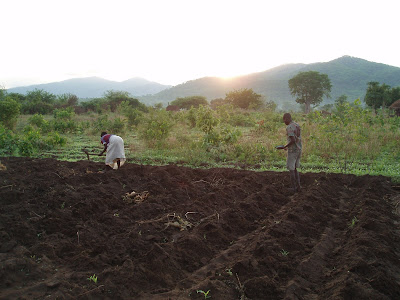
I stayed with the Wadi family, the elder brother of the village chief, and his family. With 8 children, the youngest Omali, 14, still lived at home. The fourth born, Estere, 28, and her 3 children, Amina, 11, Malugula, 6, and Twaina, 4, has moved home to stay with her parents after the recent death of her husband in August of this year. I stay in a grass thatched house with the women and the two youngest children. We sleep on reed mats on the dirt floor and try to avoid the drips of rain coming through the roof. The day begins at 4:30AM when I set off with Estere and Mrs. Wadi into the fields to get some work done before the sun rises too high in the sky. We work with hoes to make ridges in the dirt, raising the planting soil and making channels for flowing rain water. The women chatter, the kids run around, Mrs. Wadi points this way and that, aiming me towards places to work and every so often scolding me good-heartedly in Chichewa because I’ve damaged a new maize stalk just budding. Everyone watches me carefully with a mix of intrigue and disbelief. Some think it’s funny, others are impressed to see me working and appreciative of my efforts, however bad they may be. There is always an inspection of my blistered hands at the end of 2 to 3 hours in the fields. We then head back to the house to collect buckets and head the approximately 200 m to the village tap. Luckily, being a relation of the chief, the tap is not located too far away. We wait at the tap with the other women and children and once my bucket (the smallest of them all) is filled, a woman helps me hoist it on my head and I start back to the house. Carrying about 15L of water on your head is tough and heavy! It hurts your neck, it’s hard to balance as the water sloshes around above, dripping over the edge and down your face, and making your hands slippery and hard to grip. I waddle, dodging low hanging branches, with water dripping down my face, not nearly as elegantly as the women around me who flow down the path carrying larger buckets balancing on their heads and babies on their backs.

 Pumping water from a borehole

As we pick our way down to the river and then back home, we stop periodically along the way to visit with community members, interested in the strange visitor amongst them. I am repeatedly presented with gifts of fresh fruits or eggs and am struck by the kindness and generosity of the people, especially given how little they have. I can’t help but think that if roles were reversed, and I was surviving on so little and struggling to feed my family, would I be as willing to share what little I had with a visitor who came wanting to learn the language and “see how I live”, decked out with clean clothes and soft hands, who has clearly come from a land of much more wealth and opportunity? I doubt it.

I stayed with the Wadi family, the elder brother of the village chief, and his family. With 8 children, the youngest Omali, 14, still lived at home. The fourth born, Estere, 28, and her 3 children, Amina, 11, Malugula, 6, and Twaina, 4, has moved home to stay with her parents after the recent death of her husband in August of this year. I stay in a grass thatched house with the women and the two youngest children. We sleep on reed mats on the dirt floor and try to avoid the drips of rain coming through the roof. The day begins at 4:30AM when I set off with Estere and Mrs. Wadi into the fields to get some work done before the sun rises too high in the sky. We work with hoes to make ridges in the dirt, raising the planting soil and making channels for flowing rain water. The women chatter, the kids run around, Mrs. Wadi points this way and that, aiming me towards places to work and every so often scolding me good-heartedly in Chichewa because I’ve damaged a new maize stalk just budding. Everyone watches me carefully with a mix of intrigue and disbelief. Some think it’s funny, others are impressed to see me working and appreciative of my efforts, however bad they may be. There is always an inspection of my blistered hands at the end of 2 to 3 hours in the fields. We then head back to the house to collect buckets and head the approximately 200 m to the village tap. Luckily, being a relation of the chief, the tap is not located too far away. We wait at the tap with the other women and children and once my bucket (the smallest of them all) is filled, a woman helps me hoist it on my head and I start back to the house. Carrying about 15L of water on your head is tough and heavy! It hurts your neck, it’s hard to balance as the water sloshes around above, dripping over the edge and down your face, and making your hands slippery and hard to grip. I waddle, dodging low hanging branches, with water dripping down my face, not nearly as elegantly as the women around me who flow down the path carrying larger buckets balancing on their heads and babies on their backs.
Mrs. Wadi and Omali working in the fields as the sun rises behind
After bathing and breakfast, most of the rest of the day is spent in the shade, visiting with the steady stream of visitors, preparing food for the next meal, munching on mangoes, and pounding maize (painful on my already blistered hands). I try to assist with food preparation but am ushered out of the kitchen enclosure on multiple occasions because the smoke from the fire is making my eyes water. When sitting with visitors, I have my face in my Chichewa book trying to find the words to ask the questions I’m forming in my mind. Although my Chichewa definitely got better out of necessity – no one in the Wadi family speaks English and very few people in the village in general – my inability to communicate well inhibited how much I could learn about the project questions I had. I did manage to find out some things but not as much as I would have through an interpreter. I did, however, manage some information gathering through a mix of broken Chichewa, English and charades.
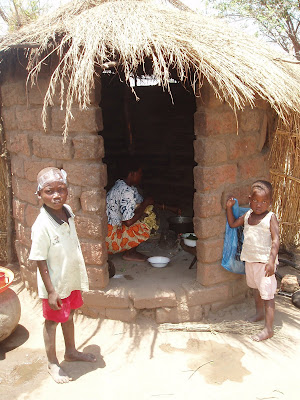
Estere in the kitchen with Malugula & Twaina looking on
Trying my hand at pounding maize
One afternoon, after the real heat of the day had passed, Mrs. Wadi, Estere and her friends Patuma and Bedina and I set off on a walk to go and see the nearby Shire River. Along the way we stop at the borehole in the next village so I can test out my first handpump in Malawi. The gravity systems in Malawi are largely the legacy of Malawi’s first president. Boreholes, however, were the flavour of the day for the second president. As a result, in the same area serviced by a gravity fed system, you also find a smattering of boreholes, often in very close proximity. The problem that arises is that when a tap breaks down or the gravity system requires repairs and an alternative water source in the form borehole is available, the urgency to repair the system is lost and many downstream users who may not have as reliable alternate sources, are negatively impacted.
Pumping water from a boreholeThe second stop on our walk is to visit Agnes Wilson. Somewhat of a legend in the area, Agnes is the survivor of a crocodile attack in 1999. At that time, before the start of the system rehabilitation, the gravity fed system was no longer functioning and Agnes went daily to the Shire River to collect her household’s water. One day, while drawing her water bucket from the river, a crocodile emerged out of the depths and grabbed her right wrist. Although, she managed to escape and has since recovered remarkable use of her hand, the incident still seems very fresh. The tap in her community is now flowing thanks to the rehabilitation work but still lacks a proper tap, funds for which have yet to be collected from the tap users.
Agnes Wilson
As we pick our way down to the river and then back home, we stop periodically along the way to visit with community members, interested in the strange visitor amongst them. I am repeatedly presented with gifts of fresh fruits or eggs and am struck by the kindness and generosity of the people, especially given how little they have. I can’t help but think that if roles were reversed, and I was surviving on so little and struggling to feed my family, would I be as willing to share what little I had with a visitor who came wanting to learn the language and “see how I live”, decked out with clean clothes and soft hands, who has clearly come from a land of much more wealth and opportunity? I doubt it.
Gifts of mangoes and papayas
So I head back to Machinga with a greater appreciation of the hardships of village life. There is a prevailing sense of struggle in daily life for the people in these communities. Every aspect of life is that much more difficult – cooking, finding food, cleaning, money, education, water. There is never a vacation, a day off, a rest. It gives me renewed drive to do what little I can to at least make the water component of life more accessible and a just a bit easier then it is right now.
Monday, November 5, 2007
Development thinking...
I struggle to know what to write on my blog and what would be of interest to people back home (hence my lack of writing in so long!). I’ve decided I’m going to try to write once a month. I’m going to alternate months, writing about some “development” topic that I’m thinking about or working on and alternate that with some funny or personal story that will hopefully be interesting. So this month, I’m in the development mood, having just come off of a week of EWB training/Southern Africa (SA) retreat and have a lot of thoughts floating around in my mind. The training/retreat was really helpful in pulling us out of our placements where we can get bogged down in the daily trials and frustrations of our projects and stepping back to look at the larger picture or context into which our project and/or placement fits. It also was helpful that we were able to hold these meetings in some pretty ideal locations. We set up a makeshift classroom in a shelter on the beach in Senga Bay for our training and then traveled to Zomba Plateau where we met up with the other SA OVS in a beautiful mountain setting for the retreat. So here goes…
Within the water and sanitation sector in Malawi, and I would guess in most other developing countries, the lack of capacity of the government has been identified as one of the challenges in the development of the sector. In Canada, or Ontario at least, the municipal government has the sole responsibility for providing access to safe water and sanitation. Users pay water fees to the municipal government who, for the most part, owns and manages the systems. The provincial government sets guidelines and regulations on everything from treatment and testing requirements to minimum service levels, from design guidelines to training requirements for water/wastewater system operators. These regulations must be strictly followed at the risk of hefty fines. Here in Malawi, however, the government ministry responsible for water and sanitation exists at a national level. In theory, this national ministry sets similar guidelines and regulations and, in accordance with the decentralization policy, the district government provides coordination and planning of the wat/san activities occurring within their boundaries. The NGOs, however, are largely responsible for project implementation, or the installation of the capital works and the operations/maintenance and overall management of the system is the responsibility of the beneficiary community.
There are several capacity shortfalls within the institutional system that are causing systemic challenges and difficulties in the sector. The first and probably the most significant, is the availability of qualified staff. At the national level, the ministry has made great improvements having recently released a National Water Policy and they have a National Sanitation Policy available in draft form. These guiding documents are helpful in consolidating a sector that has previously been divided into many sectors such as Health (sanitation) and Agriculture (irrigation), given the multi-sector aspects of water. Previously each of these ministries had policies on water that were often overlapping or contradictory. That being said, there is, however, no guideline on water quality monitoring or testing or other important guiding information due to the lack of capacity (skills and people) to put the time and effort necessary into the development of these documents. At a district level, the ministry is severely understaffed. In my district for example, there is one manager and about 4 technical/field staff for an area that is probably the size of Ottawa, give or take. Some districts don’t even have a manager! It’s impossible with so few people and resources to be able to adequately coordinate and plan the sector, keeping track of the various actors, developing and enforcing regulations.
This brings me to my next challenge, which is a lack of accurate information. In my limited experience here, I have not seen a lot of baseline information that is required for the successful coordination and planning of the sector. WaterAid has been instrumental in making some improvements to this shortfall by the creation of waterpoint mapping, a map of each district showing the location of each of the waterpoints, the type (public tap versus borehole) and their functionality (whether or not it is working). This is extremely valuable for planning purposes, to know which communities are well served and which are not, to know what systems need rehabilitation, etc. However, this exercise was completed for some districts up to 4 or 5 years ago, and given the resource shortfall, has not been updated since. In addition, there is insufficient hydrogeological or water quality data so it is difficult to track changes that may be occurring overtime.
One of the opportunities I may have while I’m here is to work on the development of district wide water and sanitation plans which will serve as a sector planning document for the district government and to assist in capacity development at a district level. While I see a great need and value for this I have several questions. First, is there a threshold capacity that needs to exist that makes it worthwhile to invest in capacity building? For instance, if I can assist in building the capacity of the small staff that are available, will this improve things in a larger sense within the sector at district level if these people are so overstretched in terms of resources and finances, it’s like working with one hand tied behind their backs? Is it worthwhile to invest in the creation of a plan, if they do not have the capacity to use it, enforce it and update it so it remains a useful document? Given how overstretched the existing staff are, do they have the motivation to continue to strive for improvements in the sector in their area? How can we create a useful plan given the lack of available baseline information and how can we improve this information given the currently strained human resources?
Anyways, all difficult questions and ones I currently do not have the answers to but hope that with time, I may be able to figure out. That’s all for now, hopefully all is well back home!
Within the water and sanitation sector in Malawi, and I would guess in most other developing countries, the lack of capacity of the government has been identified as one of the challenges in the development of the sector. In Canada, or Ontario at least, the municipal government has the sole responsibility for providing access to safe water and sanitation. Users pay water fees to the municipal government who, for the most part, owns and manages the systems. The provincial government sets guidelines and regulations on everything from treatment and testing requirements to minimum service levels, from design guidelines to training requirements for water/wastewater system operators. These regulations must be strictly followed at the risk of hefty fines. Here in Malawi, however, the government ministry responsible for water and sanitation exists at a national level. In theory, this national ministry sets similar guidelines and regulations and, in accordance with the decentralization policy, the district government provides coordination and planning of the wat/san activities occurring within their boundaries. The NGOs, however, are largely responsible for project implementation, or the installation of the capital works and the operations/maintenance and overall management of the system is the responsibility of the beneficiary community.
There are several capacity shortfalls within the institutional system that are causing systemic challenges and difficulties in the sector. The first and probably the most significant, is the availability of qualified staff. At the national level, the ministry has made great improvements having recently released a National Water Policy and they have a National Sanitation Policy available in draft form. These guiding documents are helpful in consolidating a sector that has previously been divided into many sectors such as Health (sanitation) and Agriculture (irrigation), given the multi-sector aspects of water. Previously each of these ministries had policies on water that were often overlapping or contradictory. That being said, there is, however, no guideline on water quality monitoring or testing or other important guiding information due to the lack of capacity (skills and people) to put the time and effort necessary into the development of these documents. At a district level, the ministry is severely understaffed. In my district for example, there is one manager and about 4 technical/field staff for an area that is probably the size of Ottawa, give or take. Some districts don’t even have a manager! It’s impossible with so few people and resources to be able to adequately coordinate and plan the sector, keeping track of the various actors, developing and enforcing regulations.
This brings me to my next challenge, which is a lack of accurate information. In my limited experience here, I have not seen a lot of baseline information that is required for the successful coordination and planning of the sector. WaterAid has been instrumental in making some improvements to this shortfall by the creation of waterpoint mapping, a map of each district showing the location of each of the waterpoints, the type (public tap versus borehole) and their functionality (whether or not it is working). This is extremely valuable for planning purposes, to know which communities are well served and which are not, to know what systems need rehabilitation, etc. However, this exercise was completed for some districts up to 4 or 5 years ago, and given the resource shortfall, has not been updated since. In addition, there is insufficient hydrogeological or water quality data so it is difficult to track changes that may be occurring overtime.
One of the opportunities I may have while I’m here is to work on the development of district wide water and sanitation plans which will serve as a sector planning document for the district government and to assist in capacity development at a district level. While I see a great need and value for this I have several questions. First, is there a threshold capacity that needs to exist that makes it worthwhile to invest in capacity building? For instance, if I can assist in building the capacity of the small staff that are available, will this improve things in a larger sense within the sector at district level if these people are so overstretched in terms of resources and finances, it’s like working with one hand tied behind their backs? Is it worthwhile to invest in the creation of a plan, if they do not have the capacity to use it, enforce it and update it so it remains a useful document? Given how overstretched the existing staff are, do they have the motivation to continue to strive for improvements in the sector in their area? How can we create a useful plan given the lack of available baseline information and how can we improve this information given the currently strained human resources?
Anyways, all difficult questions and ones I currently do not have the answers to but hope that with time, I may be able to figure out. That’s all for now, hopefully all is well back home!
Monday, September 24, 2007
A bit about work....
I’ve had some questions recently about what exactly I’m doing at work so I thought I’d try to clarify a few things here. In Machinga, I’m working with a partner of WaterAid’s. WaterAid itself does not undertake the implementation of projects, but instead, serves as a funding agency providing technical and other support to local NGO’s responsible for project implementation. The rationale is that by working with local NGO’s, we are building the capacity of these organizations to implement similar projects, assisting them also with identifying other funding opportunities outside of WaterAid, therefore, in the future, these organizations should be able to function independently. The organization I work with here is called Target National Relief and Development (TANARD). In Machinga, TANARD is responsible for the rehabilitation of two gravity fed water schemes, as well as the working towards increased sanitation and hygiene education in the beneficiary communities. In all water projects, there must be an element of sanitation and hygiene as the full health benefits of providing clean water can not be achieved without the associated hygiene education. For example, if clean water is being provided, but collected in unclean buckets or food is being prepared without clean hands, etc., the full benefits of the water will not be realized.
Day to day we are undertaking a number of different activities. We work very closely with community management committees as well as the district government (which is roughly equivalent to the municipal government back home). The purposes of these collaborations are many. The government of Malawi has a very strong decentralization policy, on the basis that local government and communities are the most knowledgeable about the resources and needs in their areas. Within these two schemes as well as most water systems, the communities are responsible for the operation and maintenance of the system. Committees are set up on a number of levels. Tap Committees are set up for each tap (of which there are hundreds). These committees are responsible for collecting user fees from the beneficiaries and reporting any required maintenance. The schemes are divided into several sections that each has a committee. These Section committees are responsible for the overall coordination of the system in their section. In addition, each section has a Repair Team, made up of individuals trained in the maintenance and the system, who are dispatched when problems are reported. There is also an overall Main Committee who looks at the system as a whole, investigates opportunities for expansion and works to develop solutions to challenges within the system such as vandalism and low community participation.
The district government is responsible for the overall development of the district, including water and sanitation. Given the current capacity of the government, however, they are responsible for so many other areas, that they rely on local NGO’s to assist in the implementation of various projects. Their involvement, however, is paramount as ultimately, the development that occurs within their area is their responsibility. This has been a problem with other NGOs in the past that do not work through the government, therefore, government is unaware of their activities which often leads to duplication or the implementation of projects that are unnecessary or not coordinated well with other development in the area. For instance, we are working to rehabilitate two of the gravity fed systems but if another NGO begins to drill boreholes in the same area, this will have a significant impact on our project success.
On a daily basis we are undertaking a variety of activities. We are currently supervising the construction of 60 tap aprons. These concrete platforms serve to protect the area around the tap from contamination and divert waste water away from the area. In this activity we are working with local contractors, therefore, we are also trying to forge relationships and develop the capacity of the private sector in water service provision. We are also working with local masons in the construction of concrete latrine slabs. Many communities, if they have latrines, have latrine floors constructed of hardened dirt. Due to the soil conditions, however, these are prone to collapse. Concrete slabs are more durable and can be reused on a new latrine if the existing one becomes full. We are also promoting the construction of ecological sanitation latrines as an alternative to the traditional types. These latrines have two pits, one of which is used at a time. When the pit becomes full, the other pit is used and the contents of the first pit are left for 6 months after which can be harvested and used as fertilizer on crops, similar to manure. This has seen to be very successful in some communities but not in others often due to cultural or religious differences. We are also supervising the communities in trench digging and pipe laying for system expansion or the rehabilitation of some portions of the scheme that have historically not been performing well. We work with local bands to develop songs promoting hygiene and sanitation messages and then organize band performances in various beneficiary communities. We assist in the planting of trees around the system river catchments and help in disseminating environmental education to communities living near the source waters, to help combat soil erosion and other environmental degradation that is threatening the quality of the source water. We undertake household sanitation and hygiene surveys to identify the current sanitation and hygiene practices and assist in the development of our sanitation and hygiene education programs. We also assist the communities in providing technical or management assistance where required. All this, just to name a few! So it’s quite an exciting project with many facets. There are many challenges, both internally to the organization in terms of logistics, etc. as well as in working with the communities but perhaps I’ll leave those for another entry. Hopefully this gives you a better idea of what I’m working on day to day.
Day to day we are undertaking a number of different activities. We work very closely with community management committees as well as the district government (which is roughly equivalent to the municipal government back home). The purposes of these collaborations are many. The government of Malawi has a very strong decentralization policy, on the basis that local government and communities are the most knowledgeable about the resources and needs in their areas. Within these two schemes as well as most water systems, the communities are responsible for the operation and maintenance of the system. Committees are set up on a number of levels. Tap Committees are set up for each tap (of which there are hundreds). These committees are responsible for collecting user fees from the beneficiaries and reporting any required maintenance. The schemes are divided into several sections that each has a committee. These Section committees are responsible for the overall coordination of the system in their section. In addition, each section has a Repair Team, made up of individuals trained in the maintenance and the system, who are dispatched when problems are reported. There is also an overall Main Committee who looks at the system as a whole, investigates opportunities for expansion and works to develop solutions to challenges within the system such as vandalism and low community participation.
The district government is responsible for the overall development of the district, including water and sanitation. Given the current capacity of the government, however, they are responsible for so many other areas, that they rely on local NGO’s to assist in the implementation of various projects. Their involvement, however, is paramount as ultimately, the development that occurs within their area is their responsibility. This has been a problem with other NGOs in the past that do not work through the government, therefore, government is unaware of their activities which often leads to duplication or the implementation of projects that are unnecessary or not coordinated well with other development in the area. For instance, we are working to rehabilitate two of the gravity fed systems but if another NGO begins to drill boreholes in the same area, this will have a significant impact on our project success.
On a daily basis we are undertaking a variety of activities. We are currently supervising the construction of 60 tap aprons. These concrete platforms serve to protect the area around the tap from contamination and divert waste water away from the area. In this activity we are working with local contractors, therefore, we are also trying to forge relationships and develop the capacity of the private sector in water service provision. We are also working with local masons in the construction of concrete latrine slabs. Many communities, if they have latrines, have latrine floors constructed of hardened dirt. Due to the soil conditions, however, these are prone to collapse. Concrete slabs are more durable and can be reused on a new latrine if the existing one becomes full. We are also promoting the construction of ecological sanitation latrines as an alternative to the traditional types. These latrines have two pits, one of which is used at a time. When the pit becomes full, the other pit is used and the contents of the first pit are left for 6 months after which can be harvested and used as fertilizer on crops, similar to manure. This has seen to be very successful in some communities but not in others often due to cultural or religious differences. We are also supervising the communities in trench digging and pipe laying for system expansion or the rehabilitation of some portions of the scheme that have historically not been performing well. We work with local bands to develop songs promoting hygiene and sanitation messages and then organize band performances in various beneficiary communities. We assist in the planting of trees around the system river catchments and help in disseminating environmental education to communities living near the source waters, to help combat soil erosion and other environmental degradation that is threatening the quality of the source water. We undertake household sanitation and hygiene surveys to identify the current sanitation and hygiene practices and assist in the development of our sanitation and hygiene education programs. We also assist the communities in providing technical or management assistance where required. All this, just to name a few! So it’s quite an exciting project with many facets. There are many challenges, both internally to the organization in terms of logistics, etc. as well as in working with the communities but perhaps I’ll leave those for another entry. Hopefully this gives you a better idea of what I’m working on day to day.
Subscribe to:
Posts (Atom)